Find out what deck repair contractors do, signs your deck needs repair, and how to choose the right contractor for safe, lasting results at home.
A safe, usable deck depends on more than sturdy-looking boards. Moisture can damage the framing beneath the surface, rusted fasteners can weaken connections, and a loose ledger can allow water to reach your home’s structure. Experienced deck repair contractors know where to look and how to separate cosmetic wear from problems that require prompt attention. If your deck feels unstable or shows signs of rot, avoid covering the damage with stain or new boards. AllFix helps property owners throughout Grant, Adams, and Spokane Counties address deck repairs alongside fencing, painting, remodeling, electrical work, and other maintenance needs.
Key Takeaways
- Inspect beyond the surface: Check deck boards, stairs, railings, framing, posts, footings, fasteners, and the ledger connection to identify hidden damage.
- Respond to safety concerns quickly: Soft wood, sagging, shifting, loose stairs, corroded hardware, and ledger separation may require professional repairs before the deck is used.
- Hire a qualified local contractor: Compare detailed estimates, confirm Washington registration and insurance, and choose a provider with experience serving homes, rentals, and commercial properties.
What Do Deck Repair Contractors Do?
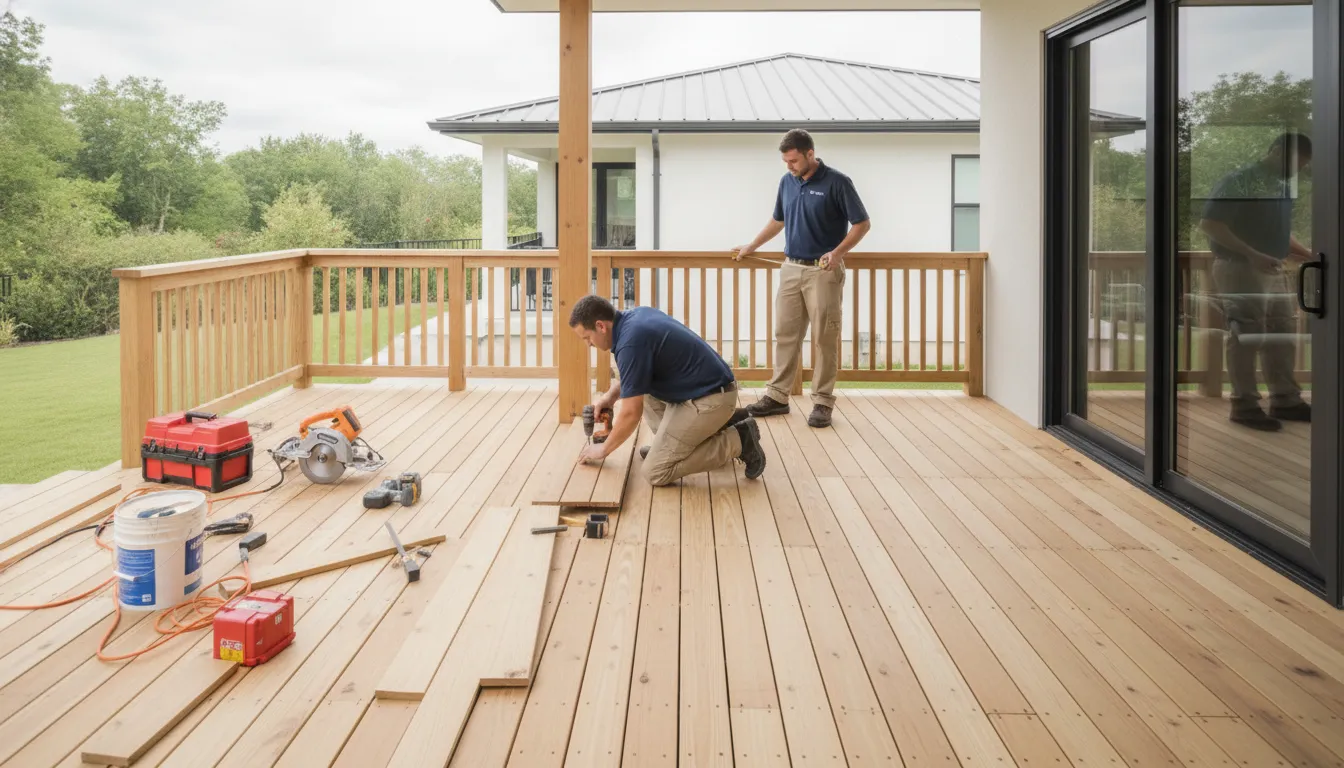
Deck repair contractors do more than replace a few worn boards. They inspect the entire structure, identify the source of the damage, and recommend repairs that address safety, durability, and appearance. A soft deck board, for example, may point to moisture damage affecting the joists below. AllFix provides handyman services for homeowners, landlords, and property managers throughout Grant, Adams, and Spokane Counties.
Here are the main tasks deck repair contractors handle:
- Inspect decks and assess safety: Contractors examine the whole structure, including the connection to the home, and may recommend keeping people off the deck until unstable stairs, loose railings, or damaged framing are addressed.
- Replace damaged boards: Cracked, warped, or rotting boards are replaced only after the framing underneath is checked. Installing new boards over damaged joists leaves the underlying problem unresolved.
- Repair stairs, railings, and landings: Loose treads, unstable stringers, and moving posts can increase the risk of a fall, so the complete stair system should be examined.
- Repair posts, joists, beams, and footings: Framing damage can stay hidden beneath the deck boards, so a contractor may remove selected boards to inspect the structure. Covering a deteriorated structural component with new boards can create a false sense of safety.
- Repair ledgers, flashing, and house connections: Failed flashing or poor drainage at the ledger can let water reach the wall structure and cause hidden rot. Do not ignore a gap between the deck and the house, visible staining, or movement at the connection.
- Treat rot, water, mold, mildew, and pest damage: Applying stain over rotten or contaminated material will not solve the problem.
- Replace loose fasteners and corroded hardware: A loose screw is not always a simple tightening job. If the surrounding wood has deteriorated, the board may need replacement or the connection may need reinforcement.
- Clean, seal, stain, and maintain decks: Excessive cleaning pressure can damage wood fibers. Maintenance does not replace structural repairs, but it can reduce moisture-related wear.
AllFix also handles related remodeling projects when deck repairs connect with broader exterior improvements.
What Signs Mean Your Deck Needs Repair?
Inspect your deck several times a year, especially before hosting guests or placing heavy furniture outside. A visual inspection can help you identify warning signs, but it cannot confirm whether the framing or foundation is safe.
Common warning signs
- Soft, cracked, or crumbling wood: Press lightly on suspicious areas with your foot or the handle of a screwdriver. Wood that feels soft, spongy, or crumbly may have rot below the surface. The Sinrom Construction deck repair guide also recommends checking for boards that hold moisture or pull away from their fasteners.
- Sagging, bouncing, shifting, or uneven boards: If one section bounces, dips, or shifts under normal foot traffic, the cause may extend into the framing or posts.
- Loose boards, stairs, railings, and connections: Gently pull on railings and check that stair treads stay firmly attached. Avoid tightening hardware into wood that has already softened or crumbled.
- Discoloration, peeling, mold, and mildew: These signs mean moisture is staying on or inside the wood. Cleaning may improve the appearance, but it will not repair softened wood.
- Rusted hardware, exposed fasteners, and widening gaps: Large gaps, shifted boards, or openings around stairs and posts may indicate movement below the surface. Do not simply drive loose nails back into rotten wood.
- Ledger separation or movement: The ledger carries part of the deck’s load, so any separation deserves prompt attention. Do not cover a separation with new boards or trim.
Perform safe checks and know when to stop using the deck
Walk slowly over areas that appear solid, look underneath the deck from ground level, and take photos of damaged areas. Do not crawl beneath a deck that appears unstable, remove structural components, or climb onto a damaged railing. Keep children and pets away while you inspect.
Stop using the deck if you notice severe sagging, significant movement, broken railings, loose stairs, large areas of rotten wood, or a connection pulling away from the house. Block access with a temporary barrier, keep heavy items off a questionable deck, and inform the owner or manager if it belongs to a rental or commercial property.
Small delays can create bigger risks: early repairs are often more focused than work performed after rot reaches joists, beams, posts, or the home’s framing.
How Can You Find Reliable Local Deck Repair Contractors?
You need a professional who can identify the source of the damage, explain which repairs are necessary, and complete the work safely. A careful hiring process can help you avoid unclear pricing, unfinished work, and temporary repairs that hide deeper structural problems.
- Search Grant, Adams, and Spokane County contractors: Look for professionals serving Moses Lake, Ephrata, Quincy, Othello, Soap Lake, Warden, and nearby areas.
- Ask for referrals: Neighbors, landlords, and property managers can tell you whether the final price matched the estimate and the work held up.
- Check reviews, references, and photos: Repeated complaints about missed appointments, unclear estimates, or unfinished work deserve attention.
- Verify Washington registration, bonding, and insurance: The Washington State Department of Labor & Industries contractor lookup lets you check a contractor’s registration status.
- Confirm experience with wood, composite, and structural repairs: Choose someone who can assess structural parts, not just replace visible boards.
- Request an in-person inspection and written estimate: The estimate should list the work, materials, labor, preparation, cleanup, and disposal, and explain how hidden damage will be handled.
- Compare contractors for homes, rentals, and commercial properties: A company that offers both property maintenance and commercial services may be able to coordinate exterior repairs with tenant improvements, electrical work, or remodeling.
Be cautious if a contractor provides a price without inspecting the deck, gives an estimate that only says “repair as needed,” pressures you to sign immediately, or asks for an unusually large upfront payment. Compare several itemized estimates rather than automatically choosing the lowest price.
How Much Do Deck Repairs Cost?
Deck repair costs vary based on the size of the damaged area, the condition of the framing, the materials involved, and how easy the deck is to access. HomeGuide’s deck repair cost guide offers broad national estimates, but local labor rates, material availability, and site conditions will affect your final price in Grant, Adams, and Spokane Counties.
Compare costs for minor, moderate, and extensive repairs
- Minor repairs often cost about $200 to $500, such as replacing a few boards or tightening hardware.
- Moderate repairs can cost approximately $500 to $2,500, such as rebuilding stairs or addressing localized rot.
- Extensive repairs can cost $2,500 or more when the work involves posts, beams, joists, footings, ledger connections, or a large portion of the deck.
These figures are general starting points, not firm quotes. A contractor needs to inspect the deck before giving you a dependable price.
What affects the price
- Labor, access, and complexity: A repair that looks simple from above may require removing several layers of decking to reach damaged framing.
- Materials: Composite decking usually costs more upfront than basic wood, and finding an exact match for an older color or profile can be difficult.
- Cosmetic vs. structural work: Structural repairs usually cost more because they may require temporary support, careful removal, and properly rated hardware. Do not use stain or new decking to cover signs of structural damage, and ask the contractor to list safety-related repairs separately.
- Permits, disposal, and site preparation: Permit requirements depend on your location and the type of work. Demolition, hauling, and cleanup should appear clearly in the proposal.
- Hidden rot: Set aside money for concealed conditions. Your contractor should contact you with photos, a description, and a revised price before completing work beyond the original scope.
Compare estimates and contract terms
The lowest bid may leave out important work, use lower-grade materials, or exclude disposal and finishing. Focus on what each itemized proposal includes. Do not rely on verbal agreements when hidden rot appears. Your budget should also include ongoing maintenance.
AllFix serves homeowners, landlords, and property managers across Grant, Adams, and Spokane Counties, including Moses Lake, Ephrata, Quincy, Othello, Soap Lake, and Warden.
Should You Repair or Replace Your Deck?
The right choice depends on the type and extent of the damage, not just the deck’s appearance. An in-person inspection can separate cosmetic wear from safety concerns.
Choose targeted repairs when they make sense
Targeted repairs often make sense when the damage is limited and the deck’s main structure remains sound, such as one cracked board, a damaged stair tread, or a loose railing. Localized rot may also be repairable once the damaged material is removed, the surrounding framing checked, and the source of the moisture corrected.
Recognize when replacement may offer greater safety
Widespread rot, repeated sagging, unstable stairs, shifting posts, or a ledger pulling away from the house can indicate that individual repairs will not provide a dependable result. Replacing the surface while leaving failing joists, beams, or footings in place can lead to repeated repair bills.
Compare costs, codes, and long-term value
When both options may be reasonable, ask for one estimate for repairs and another for replacement. Changes to stairs, railings, height, size, framing, or the house connection may require permits or inspections.
Avoid covering problems and risky DIY repairs
Installing new boards over damaged framing can make a deck look complete while leaving serious risks untouched. A clean surface should never take priority over a stable frame. Basic maintenance may be manageable for a confident homeowner, but structural repairs are different: an incorrect connection, unsuitable fastener, or undersized replacement member can create a serious safety problem. Stop using the deck and call a professional if boards feel soft, stairs move, the structure shifts, or the ledger appears separated.
Waiting for perfect weather can allow rot and movement to spread, so address structural concerns first.
What Should You Ask Deck Repair Contractors Before Hiring?
A deck repair estimate should explain more than the final price. For homeowners, landlords, and property managers in Grant, Adams, and Spokane Counties, a written scope is particularly useful when repairs overlap with fence work, painting, siding, or other exterior maintenance.
- What caused the damage, and what does the quote cover? The repair should address the source, not only the symptom. The estimate should list each repair, materials, labor, disposal, preparation, and cleanup.
- What is the condition of the framing, ledger, posts, beams, and footings? If a ledger is pulling away from the home, ask whether flashing and fasteners will also be replaced.
- Which materials and fasteners will you use? Interior screws can corrode outdoors. Ask whether joist hangers, post bases, flashing, and other hardware will be rated for exterior use.
- How will new boards match the existing deck? For composite decking, ask whether the original product is still available, and confirm whether finish work is included.
- Who will arrange permits and inspections? Put that responsibility in the contract. You can review general permit information through the Washington State Department of Labor & Industries permits page, then contact your city or county for local requirements.
- Who will do the work, and do subcontractors carry insurance? Confirm liability insurance and workers’ compensation coverage, and who supervises and corrects the work.
- What is the timeline, and how are weather delays handled? Ask whether the crew will cover unfinished materials and secure the site.
- Are cleanup, disposal, and hidden damage included? Confirm that the contractor will photograph hidden damage, explain the repair, and provide a revised price before starting extra work.
- What are the payment, warranty, and change-order terms? Change orders should be written before the contractor proceeds. If you are also hiring for residential electrical work, remodeling, or property maintenance, ask whether the same terms apply across the project.
How AllFix Repairs Decks in Grant, Adams, and Spokane Counties
Deck problems rarely stop at one damaged board. When several repairs are needed, working with one local provider can make the project easier to organize.
AllFix serves homeowners, landlords, property managers, and commercial customers throughout Grant, Adams, and Spokane Counties, including Moses Lake, Ephrata, Quincy, Othello, Soap Lake, Warden, and nearby communities. The team can discuss deck and fence repairs alongside handyman work, painting, flooring, drywall, remodeling, electrical projects, and property maintenance. Commercial customers can review property repairs, tenant improvements, retail build-outs, and ongoing maintenance with one local provider.
Start with AllFix’s handyman services to review your repair needs and decide which work should happen first, or see remodeling services and commercial services for larger projects.
Related Articles
- Deck Repair vs. Replacement: What Homeowners Should Know
- Extending the Life of Your Deck: Tips for Deck Maintenance, Repairs, and Refinishing
Frequently Asked Questions
How do I know whether my deck needs a repair or full replacement?
A professional inspection can help you make that decision. Localized damage, such as a few cracked boards or one loose railing, may be repairable when the framing is stable. Widespread rot, sagging, shifting supports, unstable stairs, or ledger separation may make rebuilding a safer and more practical option.
Can deck repairs be completed during winter or rainy weather?
Some repairs can be scheduled year-round, but weather may affect the timeline. Structural safety concerns should not be postponed, while staining, sealing, and other finish work may need dry weather.
Should I repair the deck myself?
Basic upkeep may be manageable for many homeowners. Structural work involving joists, beams, posts, footings, stairs, railings, or the ledger requires careful knowledge of safe connections and outdoor materials. If the deck moves, feels weak, or shows rot, have a qualified contractor inspect it.
Does AllFix repair decks for rental and commercial properties?
Yes. AllFix serves homeowners, landlords, property managers, and commercial customers throughout Grant, Adams, and Spokane Counties, including Moses Lake, Ephrata, Quincy, Othello, Soap Lake, and Warden.
Tell Us About Your Project
Fill out the form below and we'll contact you within 1 business day.